An operations manager needs a critical software license renewed. She submits a purchase request. It sits in a queue for eleven days, bounces between two approvers who are traveling, and eventually stalls in a system nobody checks. So she puts it on a corporate card, gets the license renewed in twenty minutes, and moves on.
She knew she was bypassing the approved process. She did it anyway — because the approved process had already failed her. The PO system didn’t connect to the approval workflow. The approval workflow didn’t connect to the vendor database. Nobody could see where the request was, including the people responsible for approving it. That is not a people problem. That is what fragmented procurement systems do to an organization — and it is happening thousands of times a year across your business.
This distinction matters enormously for CFOs and CPOs trying to control spend. The question is not whether policy was bypassed — it was. The question is why disconnected systems made circumvention the only rational option. Until leadership answers that question honestly, enforcement alone will not move the needle.
What Fragmented Procurement Systems Are Actually Costing You
When employees cannot navigate disconnected systems fast enough to meet business demand, they route purchases outside approved channels — without a PO, against unapproved vendors, bypassing contract terms entirely. Each individual transaction feels harmless. The cumulative financial impact is not.
Industry benchmarks place unmanaged off-contract spend at 3% to 5% of total addressable spend. For a $500M organization, that is $15M to $25M annually transacting outside your negotiated pricing, your approved supplier base, and your compliance controls. The employee saved twenty minutes. Finance absorbed the full cost of an uncontracted vendor relationship — no volume leverage, no negotiated terms, no rebate eligibility.
Contract-compliant pricing averages 8% to 14% better than spot purchasing. Every bypass forfeits that advantage. Beyond pricing, off-contract purchases introduce audit exposure, vendor proliferation, and duplicate payment risk. AP teams cannot match what they cannot see. Finance cannot accrue what was never requisitioned. Procurement cannot negotiate better terms with a supplier whose actual transaction volume is invisible because it never entered the system.
The cost is not theoretical. It appears on your next audit, in your next supplier negotiation, and in every quarter-end variance your team cannot explain.
Fragmentation Is the Root Cause — Not Employee Behavior
A fragmented procurement environment forces employees to make a time calculation every time they need to buy something: navigate three disconnected systems, or use a corporate card and move on in four minutes.
That is not a compliance failure. That is a rational response to a broken architecture.
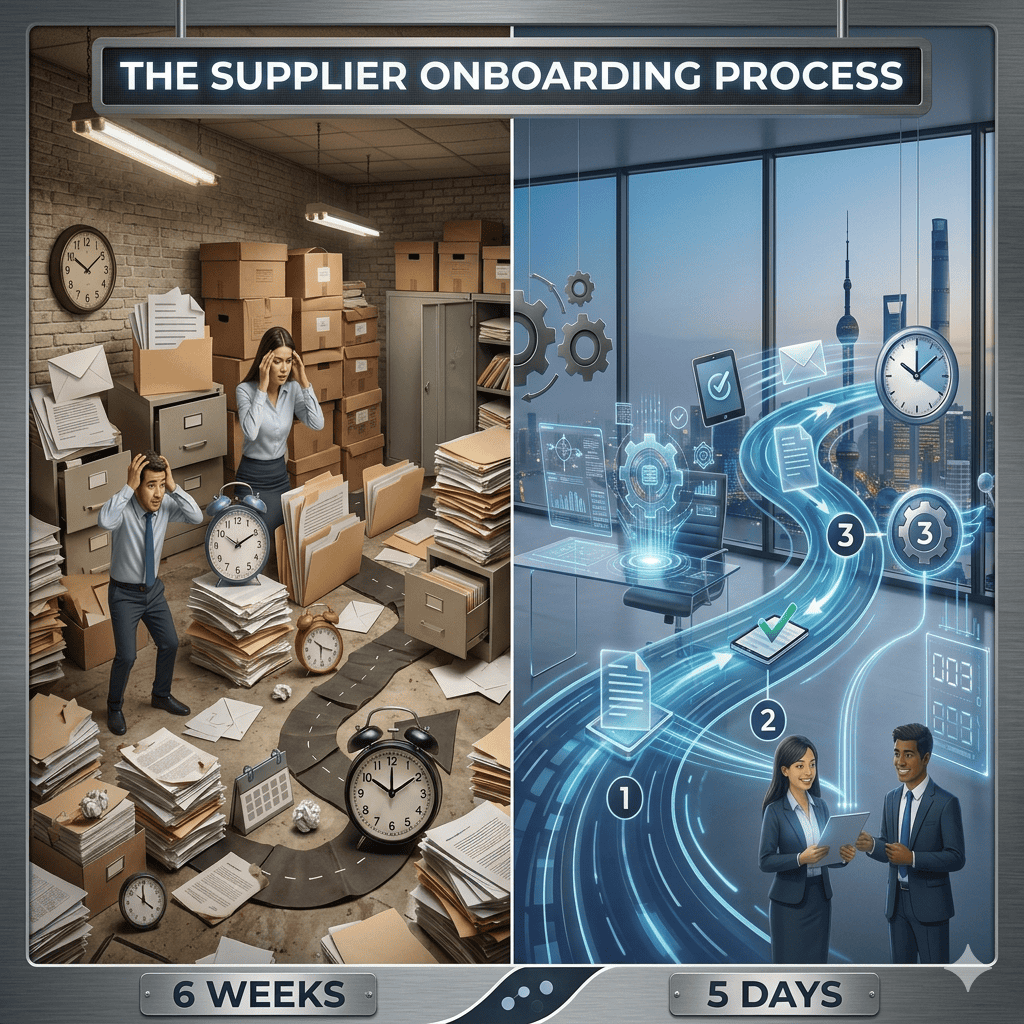
Consider what the compliant path requires in a fragmented environment: navigate to the correct intake system, locate the right category form, identify an approved supplier in a separate vendor database, submit a requisition, wait for a manager approval that routes through a different platform, wait for procurement review, wait for a PO to be issued from yet another system. In organizations where these steps span multiple disconnected tools, this sequence routinely takes two to four weeks — and nobody can tell you where it is at any given moment.
When systems do not share data, approvals stall. When approvals stall, employees stop trusting the process. When employees stop trusting the process, they stop using it. Organizations still relying on reactive, fragmented category approaches will see this behavioral pattern regardless of how many compliance reminders they issue.
The CFO sees a compliance failure. The employee sees a tool that has failed them repeatedly. Both are right — and only one of those problems is fixable with a policy memo.
The Approval Bottleneck Is Where Fragmentation Does the Most Damage
Fragmented procurement systems fail at a predictable point — the approval chain — and that failure cascades into permanent behavioral change across the organization.
When approval routing depends on manual handoffs between disconnected platforms, requests fall through the gaps. Approvers cannot see what is pending. Requestors cannot see where their submission sits. Time-sensitive purchases expire in queues that nobody monitors. Business units stop submitting and start working around the system entirely — corporate cards, personal reimbursements, informal vendor commitments that procurement discovers only when the invoice arrives.
This is shadow procurement. It is pervasive in organizations where systems cannot keep pace with operational demand, and almost entirely invisible to finance until something goes wrong. The real cost of procurement approval bottlenecks extends well beyond the delayed transaction — it trains entire departments to route around the system permanently.
The structural signature is consistent across organizations: too many sequential approvers across too many platforms, no SLA enforcement, no unified visibility into request status. These are not policy failures. They are architecture failures — and they will keep generating rogue spend until the underlying fragmentation is resolved.
A Unified System Makes Compliance the Path of Least Resistance
The organizations that have materially reduced rogue spend share a common architecture: they replaced fragmented systems with a single connected platform — and made the compliant path faster than the workaround.
That means three things in practice.
Touchless intake that actually works. AI-powered intake portals that understand natural language requests, route automatically to the correct category and supplier, and surface catalog options without requiring employees to navigate multiple systems. When a request completes in two minutes with a confident expectation of fast resolution, the corporate card loses its advantage.
Real-time spend visibility across a single data model. Rogue spend thrives in the gaps between disconnected systems. When finance can see committed spend, in-flight POs, and contract consumption in one place — not at month-end, but today — exceptions surface before they compound. Understanding why spend leakage happens and how to fix it starts with eliminating the data gaps that fragmented systems create.
Contract-aligned purchasing at the point of transaction. AI-driven 4-way match — validating PO, receipt, invoice, and contract terms simultaneously — catches off-contract purchases before payment, not after. Without enforceable contract compliance management, off-contract spend flows through undetected until the next audit cycle.
ServiceNow is the only platform where intake, approval routing, vendor validation, spend analytics, and contract compliance operate on a single data model. No reconciliation lag. No duplicate records. No blind spots created by systems that were never designed to talk to each other.
Connected Systems Are a Financial Control
Fragmented procurement systems are not just an operational inconvenience. They are a financial control failure — one that compounds quietly across thousands of transactions until it surfaces in an audit finding or a spend analysis that nobody can fully explain.
The employees going around the system are not the problem. The disconnected architecture that made the workaround faster than the process is the problem. Connect the systems, close the gaps, and rogue spend loses its conditions to exist.
ODS builds this architecture exclusively on ServiceNow, engineering procurement workflows from the employee’s experience backward. The result is spend visibility leadership can act on, compliance controls that enforce themselves, and procurement teams freed from exception management to focus on strategic sourcing.
If rogue spend is appearing in your audit findings or your spend analytics, fragmented systems are the likely cause. We can show you exactly where the gaps are — and what they are costing you.