The Business Is Waiting. But Procurement Is Still Chasing Documents.
Your operations team identified a new supplier on Monday. The need is real. Now procurement starts the clock on the supplier onboarding process—a sequence that, at most organizations, will take four to six weeks before that supplier can receive a single purchase order.
Meanwhile, the business finds workarounds. Procurement chases emails. Finance waits for banking details. Risk sits on an incomplete compliance form. And somewhere in that chaos, a critical shipment gets delayed, a project slips, or a leader loses confidence in the procurement function entirely.
Six weeks is not a compliance requirement. It is a symptom of a broken process.
Why the Supplier Onboarding Process Takes Six Weeks
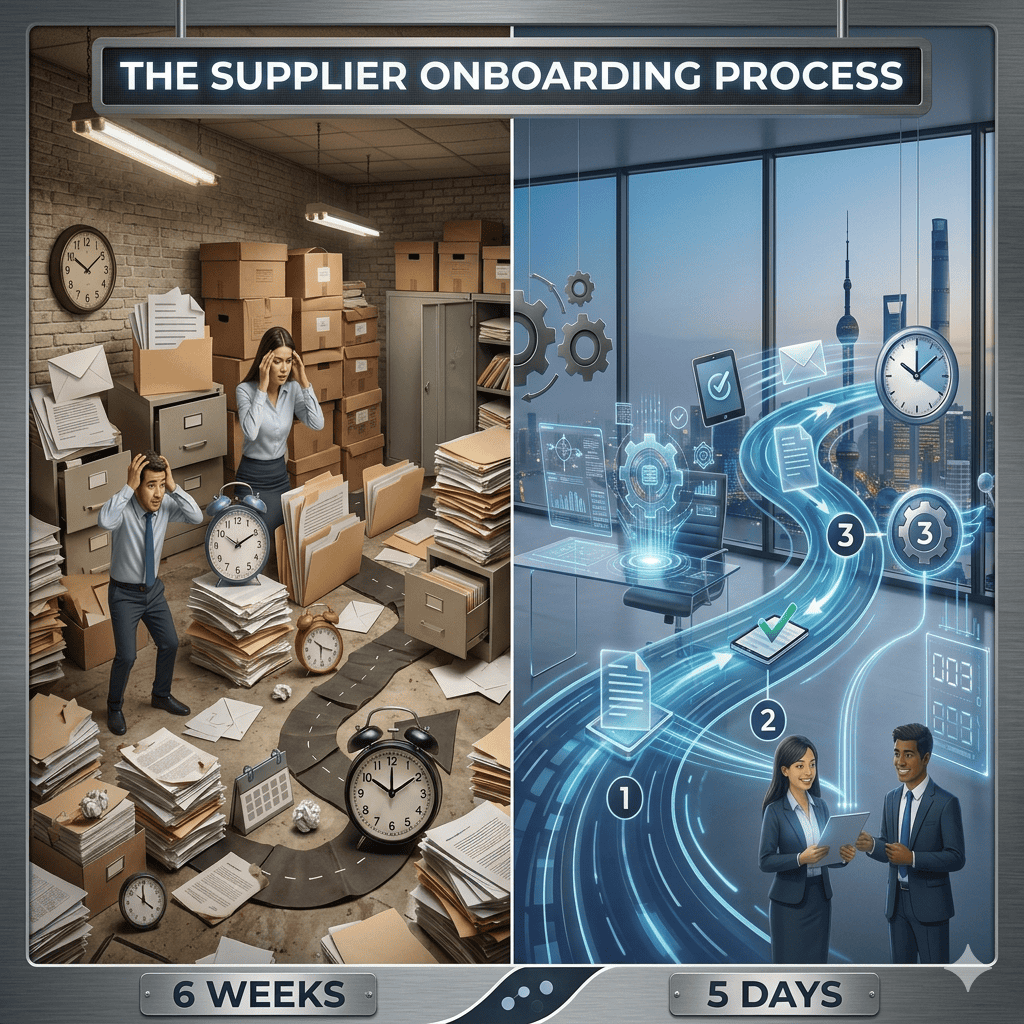
The problem is not that procurement teams are slow. It is that onboarding was designed as a collection of individual tasks rather than an end-to-end workflow. Here is where the time goes:
Week 1–2: The document collection cycle Banking details, W-9 or W-8 forms, insurance certificates, compliance attestations, tax identification. Each document goes to a different person. Each person responds on their own schedule. Procurement is not managing a process—it is managing an inbox.
Week 2–3: The validation backlog Documents arrive incomplete or in the wrong format. Procurement requests corrections. Suppliers resubmit. The cycle repeats. Nobody has visibility into what is outstanding, what has been received, or what is blocking approval.
Week 3–4: Risk and compliance review The compliance team receives a batch of new supplier files—when someone remembers to send them. Sanctions screening happens manually. Financial health checks pull from disconnected databases. Results get emailed back to procurement and attached to a SharePoint folder nobody can reliably find.
Week 5–6: ERP setup and system activation Someone submits a ticket to Finance to create the vendor record. The ticket sits in a queue. Finance needs the banking details that are in procurement’s email. Procurement sends them again. The vendor record gets created. The supplier can finally receive a PO.
Six weeks. No single person is at fault. The process itself is the problem.
What Six Weeks Actually Costs
Most organizations underestimate the business cost of supplier onboarding delays because the impact is diffuse. It does not show up on a single line item. But consider what happens at scale.
An organization managing 500 new supplier onboards per year—common for mid-market and enterprise companies—at an average of six weeks per onboarding loses the equivalent of 150 supplier-years of available capacity annually just to administrative delay.
The harder costs are operational. Delayed supplier activation means:
- Project timelines slip when critical materials or services cannot be sourced through compliant channels
- Maverick spend increases as business units bypass procurement to use suppliers they already know—whether those suppliers are approved or not
- Incumbent suppliers gain leverage because switching costs appear high when alternatives cannot be activated quickly
- Risk exposure persists for suppliers operating informally while their onboarding is “in progress”
The 6-week onboarding cycle is not just an operational inconvenience. It is a competitive and compliance liability.
What 5-Day Onboarding Looks Like
Five-day onboarding is not aspirational. It is achievable with structured workflow automation. Here is what changes:
Day 1: Supplier self-service intake The moment a new supplier is approved for onboarding, they receive a guided portal link. The portal collects banking details, tax documentation, insurance certificates, and compliance attestations in a single session. The system validates completeness in real time—not after submission. Suppliers cannot move forward with missing fields. Incomplete submissions do not enter the queue.
Day 2: Document validation and completeness review Submitted documents route automatically to procurement for a structured completeness check. The system flags missing items, format issues, and expiration dates on certificates. Any corrections are requested through the portal—not email. Suppliers receive a direct link back to the specific fields requiring attention. The back-and-forth cycle that typically consumes weeks 1 and 2 compresses into a single business day.
Day 3: Risk screening and compliance review Validated documents trigger automated sanctions screening and financial health checks against integrated data sources. Risk flags surface immediately with context—not after a human manually reviews a PDF stack. Compliance reviewers see a structured checklist with pre-populated results. Exception-based workflows mean reviewers only touch what requires judgment.
Day 4: Internal approval workflow Clean suppliers route to the appropriate approval authority based on category, spend tier, or risk classification. Approvers receive a structured summary—not a document pile. Escalation rules trigger automatically if approvals are not completed within the defined window. No manual follow-up required.
Day 5: ERP synchronization and activation Approved supplier records sync to the ERP automatically. Banking details transfer without manual re-entry. The vendor record is created. The supplier is activated and can receive a purchase order by end of day.
No email chasing. No document re-requests. No ticket queues. The process moves at the speed of the workflow—not the speed of individual inboxes.
The Architecture Behind It
Five-day onboarding requires three things working together:
1. A structured supplier portal, not a form Forms collect data. Portals guide suppliers through a validated intake experience. The difference is that portals enforce completeness before submission, reducing the back-and-forth cycle that consumes weeks 1 and 2 of the traditional process.
2. Workflow orchestration, not task management Routing, validation, screening, and approval need to happen in a connected sequence—not as independent tasks managed across email threads and spreadsheets. When each step completes, the next step triggers automatically. Exceptions route to the right person with the right context.
3. System integration, not manual hand-off The ERP vendor record should not require a separate ticket. Approved supplier data should flow directly to the systems that need it—ERP, AP, category management—without human re-entry.
Organizations that have deployed ServiceNow SLO with this architecture consistently achieve 30–40% reductions in supplier onboarding cycle time as a baseline. With a configured, outcome-focused implementation, five-day onboarding is a realistic target for most supplier categories.
The Hidden Benefit: Risk You Can Actually Manage
Fast onboarding is the visible outcome. But the structural benefit is risk visibility at scale.
When every supplier moves through the same workflow, every supplier gets the same screening. There is no exception for “we’ve worked with them before.” There is no bypass for “the business needs them urgently.” Risk assessment happens as part of activation—not as a separate process that gets deferred when things are busy.
Organizations operating with manual onboarding often discover, during an audit or an incident, that a significant percentage of their active supplier base has incomplete risk assessments. Not because anyone decided to skip them. Because the process never required completion before activation.
Workflow-enforced onboarding closes that gap before it becomes a liability.
Where to Start
If your supplier onboarding cycle is running four to six weeks, the first step is a diagnostic, not a technology decision. Identify where time is actually being lost:
- Document collection: how many rounds of re-requests per supplier?
- Validation: how long between submission and compliance review?
- ERP activation: how long between approval and system setup?
Most organizations find that two of those three stages account for 80% of the delay. That is where the workflow intervention produces the fastest results.
Five-day onboarding starts with a clear picture of where the six weeks is being spent.